
The way people search for information is changing rapidly. Instead of scrolling through pages of links, users now expect instant, accurate answers from AI-powered platforms, voice assistants, and smart search tools. These systems don’t just list websites – they interpret intent, summarise information, and recommend trusted sources in real time.
This shift has fundamentally changed how visibility works online. Traditional optimisation methods alone are no longer enough to ensure brands are discovered. As AI-driven platforms become a primary source of information, businesses must adapt their strategies to match how these systems understand and deliver content.
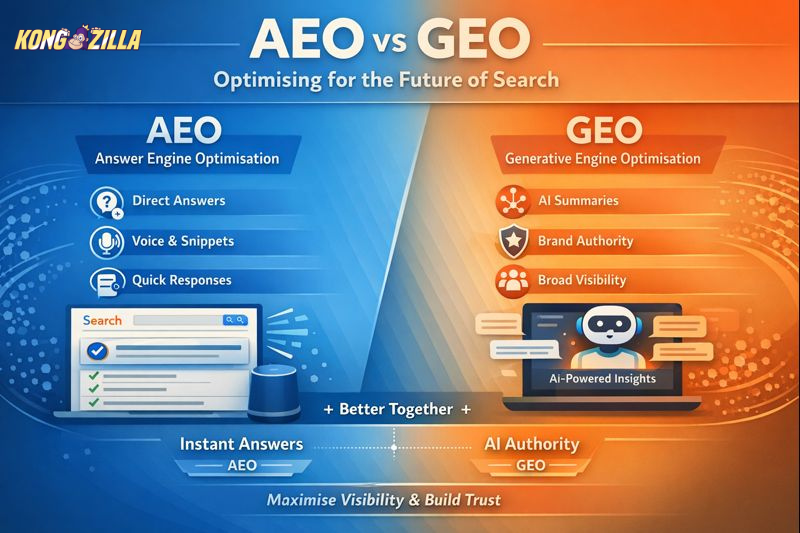
This is where Answer Engine Optimisation (AEO) and Generative Engine Optimisation (GEO) come into play. While both are designed for AI-first discovery, they serve different purposes – one focuses on providing direct, precise answers, while the other focuses on building brand authority within AI-generated responses. In this blog, we’ll break down what AEO and GEO are, how they differ, and why using both together is essential for future-ready search visibility.
What Is AEO (Answer Engine Optimisation)?
AEO focuses on optimising content so it can be selected as a direct answer by search engines and voice assistants. These answers often appear in featured snippets, “People Also Ask” sections, or voice search responses.
AEO is designed to:
- Provide clear, concise answers to specific questions
- Match conversational and voice-based queries
- Improve visibility without requiring a click
AEO works best when content is well-structured, easy to understand, and directly aligned with user intent.
What Is GEO (Generative Engine Optimisation)?
GEO focuses on optimising content and brand signals so AI systems can understand, trust, and reference your brand when generating responses. Unlike AEO, GEO is not about one direct answer. It’s about being included in broader AI-generated summaries and recommendations.
GEO helps brands:
- Appear inside AI-generated responses
- Build authority across AI platforms
- Maintain visibility even without traditional rankings
GEO operates at a broader, brand-level scope compared to AEO.
AEO vs GEO: Key Differences Explained
| Aspect | AEO (Answer Engine Optimisation) | GEO (Generative Engine Optimisation) |
| Core Objective | Provide direct, precise answers | Influence AI-generated summaries and recommendations |
| Primary Platforms | Google featured snippets, voice assistants | ChatGPT, Gemini, Perplexity, AI assistants |
| Content Focus | Question-based, concise responses | Context-rich, authoritative content |
| Search Behaviour | Immediate, intent-driven queries | Exploratory and conversational queries |
| Visibility Type | Single answer or snippet placement | Multiple brand mentions within AI outputs |
| Optimisation Level | Page or section-specific | Brand and ecosystem-level |
| Content Structure | FAQs, Q&A formats, short explanations | Long-form content, entity signals, consistency |
| Measurement | Snippet presence and impressions | Brand visibility and AI references |
| User Interaction | Often zero-click responses | Brand recognition and trust building |
| Long-Term Impact | Quick visibility for specific queries | Sustained authority in AI-driven search |
How AEO and GEO Complement Each Other
While AEO and GEO serve different purposes, they work best when implemented together. AEO ensures that your content provides clear, accurate answers that AI systems and search engines can easily extract. This helps your brand appear in featured snippets, voice search results, and direct-answer formats.
GEO, on the other hand, operates at a broader level. It focuses on shaping how AI platforms understand, interpret, and reference your brand across multiple queries. Instead of targeting a single answer, GEO builds long-term authority by ensuring your brand is consistently associated with expertise, reliability, and relevance.
When combined, AEO captures immediate visibility, while GEO strengthens brand presence within AI-generated responses.
Why Businesses Need More Than One Optimisation Approach
Search behaviour is no longer limited to typing keywords into Google. Users now ask complex, conversational questions and expect AI platforms to provide detailed explanations, comparisons, and recommendations. Relying on only one optimisation method can limit your reach.
By using both AEO and GEO, businesses can:
- Appear in direct answers and featured snippets
- Build trust within AI-generated content
- Maintain visibility across search engines and AI assistants
- Reduce dependency on traditional click-based traffic
This multi-layered approach ensures your brand stays relevant as search continues to evolve.
The Role of Content Quality and Authority
Both AEO and GEO depend heavily on content clarity and credibility. Well-structured content with accurate information helps AEO perform better, while authoritative, consistent messaging strengthens GEO signals.
High-quality content helps AI systems:
- Understand your expertise
- Associate your brand with specific topics
- Reference your business confidently in generated responses
This is why businesses focusing on long-term growth prioritise content depth, accuracy, and consistency across platforms.
Preparing for the Future of Search
As AI-driven search continues to grow, brands that adapt early gain a significant advantage. AEO helps you meet today’s search demands, while GEO prepares your brand for how information will be discovered and consumed in the future.
Together, they create a sustainable strategy that balances visibility, trust, and authority – ensuring your brand remains discoverable no matter how users search.
Final Thoughts
Search is evolving rapidly, and brands can no longer rely on a single optimisation strategy to stay visible. AEO helps your content deliver clear, direct answers, while GEO ensures your brand is recognised, trusted, and referenced within AI-generated responses. Together, they form a future-ready approach that aligns with how users now discover information.
Businesses that adapt early will not only maintain visibility but also build lasting authority across both search engines and AI platforms. This shift requires the right strategy, consistent execution, and a deep understanding of how AI interprets content.
At Kongzilla, we help you with everything—from building strong SEO foundations to implementing AEO and GEO strategies that position your brand for long-term growth. Our team ensures your content, structure, and authority are optimised to perform across traditional search and AI-driven platforms, so your business stays ahead as digital search continues to evolve.
FAQs
1. Do businesses need both AEO and GEO?
Yes. AEO helps your content appear as direct answers for specific questions, while GEO builds long-term brand authority within AI-generated responses. Using both ensures visibility across instant answers and broader AI summaries.
2. Is AEO only useful for voice search?
No. While AEO supports voice assistants, it is also essential for featured snippets, “People Also Ask” sections, and AI-powered search results where users expect quick, accurate answers.
3. How does GEO improve brand visibility without clicks?
GEO helps AI platforms recognise and trust your brand, allowing it to be referenced within generated answers and recommendations, even when users don’t visit a website directly.
4. Does implementing AEO and GEO require changing existing content?
Not always. Many improvements come from refining structure, clarity, and authority rather than rewriting everything. Optimisation focuses on how content is presented and understood by AI systems.
5. Are AEO and GEO relevant for all industries?
Yes. Any business that relies on online discovery from services and SaaS to eCommerce and local brands can benefit from improved visibility across AI-driven platforms and search experiences.

