
Search is no longer limited to typing keywords into Google. Today, people are getting answers from AI-powered platforms like ChatGPT, Gemini, Perplexity, and voice assistants. This evolution has changed how brands are discovered online and has introduced a new optimisation approach known as GEO (Generative Engine Optimisation).
While SEO remains essential, relying only on traditional search is no longer enough. Businesses that want long-term visibility must understand how SEO and GEO work together in an AI-first digital landscape.
What Is SEO (Search Engine Optimisation)?
SEO (Search Engine Optimisation) is the process of optimising your website to rank higher on search engines like Google and Bing. The goal is to attract organic traffic by improving relevance, authority, and technical performance.
Key elements of SEO include keyword research, on-page optimisation, technical SEO, content creation, and link building. SEO helps users find your website through search results, making it the foundation of digital visibility.
What Is GEO (Generative Engine Optimisation)?
GEO focuses on optimising your brand and content so AI systems can recognise, trust, and reference you when generating answers. Instead of ranking pages, AI tools summarise information and recommend sources based on context, credibility, and clarity.
GEO ensures your brand appears inside AI-generated responses, not just as a clickable link.
SEO vs GEO: Key Differences at a Glance
| Aspect | SEO (Search Engine Optimisation) | GEO (Generative Engine Optimisation) |
| Primary Focus | Ranking on search engines | Visibility in AI-generated answers |
| Platform | Google, Bing | ChatGPT, Gemini, Perplexity |
| Optimisation Style | Keyword and page-level | Context and brand-level |
| Content Priority | Keywords and structure | Meaning and clarity |
| Output | Search listings | AI summaries and mentions |
| User Action | Click-through traffic | Brand trust and influence |
| Ranking Method | Algorithms and backlinks | Authority and consistency |
| Measurement | Rankings and traffic | Visibility and references |
| Speed of Change | Gradual | Dynamic and adaptive |
| Future Readiness | Foundational | AI-first discovery |
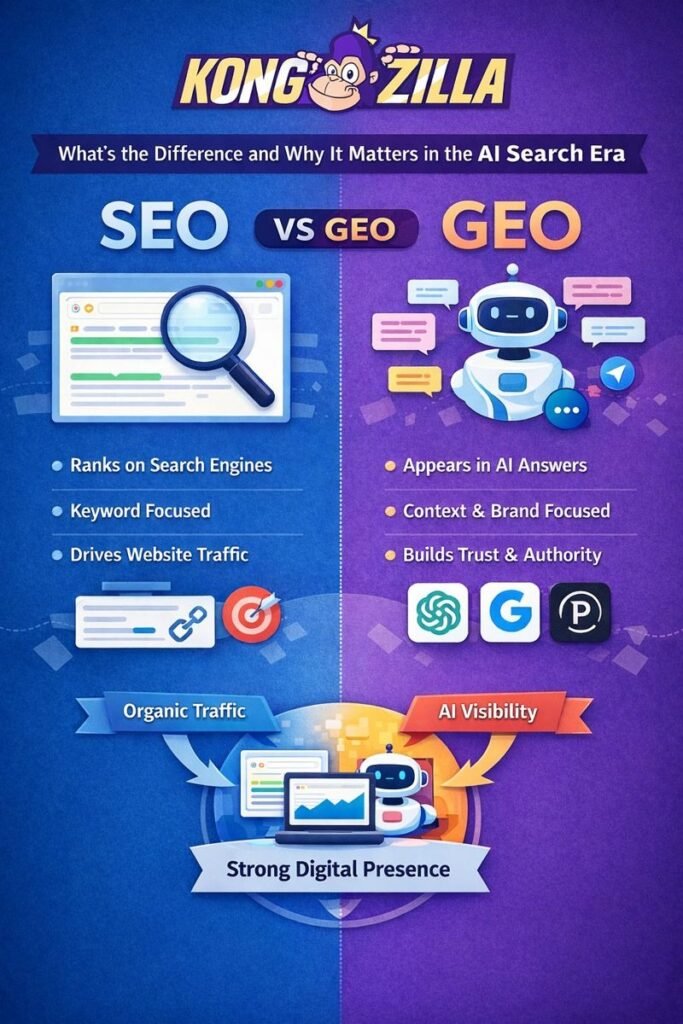
Why SEO Alone Is No Longer Enough
SEO is excellent at driving traffic, but modern search behaviour has changed. AI platforms increasingly provide direct answers, summaries, and recommendations without requiring users to click through to websites. This means that even high-ranking pages can lose visibility if they are not referenced or understood by AI systems.
If your brand is not optimised for AI visibility, you risk being excluded from these AI-driven conversations – despite ranking well on Google. As users rely more on AI tools for research, comparisons, and decision-making, traditional rankings alone no longer guarantee brand exposure or trust.
This shift is why businesses working with a top digital marketing agency in India are now investing in both SEO and GEO. While SEO builds discoverability and traffic, GEO ensures your brand is recognised, trusted, and surfaced across AI-powered platforms, creating a stronger and more future-ready digital presence.
Why SEO and GEO Work Best Together
SEO builds the foundation of digital visibility by improving discoverability, credibility, and long-term organic traffic. It ensures your website is technically sound, content-rich, and accessible to search engines. GEO builds on this foundation by positioning your brand as a trusted authority within AI-driven platforms that prioritise context, reliability, and expertise over simple rankings.
When combined, SEO and GEO create a complete visibility strategy that works across both traditional search engines and modern AI-powered tools. SEO helps users find you, while GEO ensures AI systems understand, reference, and recommend your brand during decision-making moments.
Together, they help businesses:
- Stay visible across search engines and AI platforms
- Build brand trust without relying only on clicks or rankings
- Compete effectively in saturated and highly competitive markets
- Future-proof their digital presence as search continues to evolve
By integrating SEO and GEO, businesses move beyond traffic generation and build lasting authority, relevance, and influence in an AI-first world.
Final Thoughts
SEO is evolving, not disappearing. GEO is the next layer that ensures your brand stays relevant as AI reshapes how people search, learn, and decide. Businesses that adopt SEO and GEO together today will lead the next generation of digital marketing.
At Kongzilla, we design AI-powered strategies built for search engines, answer engines, and future-ready growth.
FAQs: SEO vs GEO
1. What is the biggest difference between SEO and GEO?
The biggest difference is where visibility happens. SEO focuses on ranking websites in search results, while GEO focuses on making your brand visible within AI-generated answers, summaries, and recommendations. SEO drives clicks; GEO builds authority inside AI platforms.
2. Why is GEO important in the age of AI search?
AI tools often answer questions directly without sending users to websites. GEO ensures your brand is included in these answers, helping you stay visible and relevant even when traditional clicks decrease.
3. Can a business rely only on SEO in today’s digital landscape?
SEO is still essential, but relying on it alone limits growth. As search behaviour shifts toward AI-driven platforms, businesses need GEO to maintain visibility, credibility, and influence beyond search engine rankings.
4. How do SEO and GEO support long-term digital growth?
SEO builds a strong foundation through traffic and discoverability, while GEO strengthens brand authority across AI platforms. Together, they create sustainable visibility that adapts to how users search and consume information today.

